There are many decisions to make in buying your first or next fly rod. The choices can seem overwhelming. Before talking to a builder it would be nice to have roughly worked through what you are looking for. Where to start. Take a look at the design tool https://weymouthrodworks.com/custom-options to help you visualize your rod.
Classic Rod Makers Who Shaped the Craft
There is a certain quiet lineage in the making of bamboo fly rods—one that runs deeper than tools, deeper than tapers, and even deeper than the cane itself. It is a lineage of hands and habits, of learned feel and inherited standards. To speak of classic rod makers is not simply to list names, but to recognize a tradition shaped by a handful of craftsmen whose influence still runs, like a clean trout stream, through every careful stroke of a plane today.
At the center of that lineage stands Hiram Leonard, often regarded as the father of the modern split bamboo rod. Leonard did more than build rods—he systematized the craft. His development of the beveler and refinements in rod construction brought a new level of precision and repeatability. Before Leonard, rod making was largely a matter of individual experimentation; after him, it became a discipline. His rods carried a delicacy and consistency that set a benchmark, and perhaps more importantly, he trained others who would carry his methods forward. In that sense, Leonard didn’t just make rods—he made rod makers.
From that foundation emerged a flowering of regional styles and philosophies. Eustis Edwards, who worked under Leonard before striking out on his own, brought a fluid, almost lyrical action to his rods. There was a sense of grace in Edwards’ work, a willingness to let a rod breathe and bend in a way that felt alive in the hand. His influence can still be felt in rods that favor smoothness over stiffness, touch over power.
Then there was Everett Garrison, a man whose approach bordered on the mathematical. Garrison brought engineering rigor to rod design, carefully calculating stress curves and documenting his methods with a precision that had rarely been seen before. His collaboration with Hoagy B. Carmichael resulted in a book that remains a cornerstone of the craft. Garrison’s rods are often described as honest—progressive, predictable, and deeply satisfying. For many modern makers, his work represents the bridge between intuition and analysis.
If Garrison was the engineer, Paul H. Young was the iconoclast. Young challenged convention, experimenting with parabolic tapers that loaded deeply into the butt of the rod. His rods were not always easy, nor were they intended to be. They asked something of the angler—timing, patience, trust. But in return, they offered a kind of power and feel that was entirely their own. Today, the influence of Young’s work is unmistakable in rods designed for close-in control and dynamic casting styles.
No discussion would be complete without Jim Payne, whose rods are often considered the pinnacle of refinement. Payne rods combined elegance with performance in a way that felt effortless. Their actions were smooth, their finishes immaculate, and their reputation enduring. Even now, to cast a Payne is to understand what balance truly means—not just in weight, but in design philosophy.
These makers, among others, established more than a catalog of tapers—they defined a set of values. Precision. Patience. A refusal to compromise. An understanding that a rod is not merely a tool, but an extension of the angler’s intent.
And yet, the craft did not end with them.
Modern rod makers—many working alone in small shops not unlike those of their predecessors—continue to carry this tradition forward. They study the old tapers, sometimes replicating them exactly, other times using them as a starting point for refinement. A maker might build a Garrison-inspired progressive rod, but adjust it subtly for modern lines. Another might revisit a Young parabolic taper, softening or strengthening certain sections to suit contemporary casting styles.
What remains unchanged is the process itself. The slow, deliberate splitting of cane. The careful heat-treating. The quiet concentration at the planing form. These are not relics of the past; they are living practices, repeated daily by those who understand that speed has little place in this work.
At the same time, modern makers are not bound by tradition—they are informed by it. Advances in adhesives, finishes, and tooling have allowed for greater durability and consistency. Some makers experiment with hollow-building techniques to reduce weight while preserving strength. Others explore new ferrule designs or incorporate subtle ergonomic improvements. But even in innovation, there is a clear respect for what came before.
Perhaps the most important way in which today’s makers honor the classics is in their standards. The best among them still hold a strip of bamboo up to the light, still run their fingers across a node to feel for the slightest imperfection. They still believe, as those before them did, that nothing should leave the shop unless it represents their finest effort.
In a world that often favors speed and scale, bamboo rod making remains stubbornly slow. That is not a weakness; it is its defining strength. Each rod carries within it not just the work of the maker, but the accumulated knowledge of generations. Finally, they matter because they anchor the craft in something human.
And that is why the classic makers still matter.
Every time a modern craftsman sets a plane to cane, there is an echo of Leonard’s precision, Edwards’ grace, Garrison’s logic, Young’s daring, and Payne’s refinement. The river moves forward, but it never forgets its source.
Rattan Fly Rod Grips
Rooted in Tradition. Built for the Water.
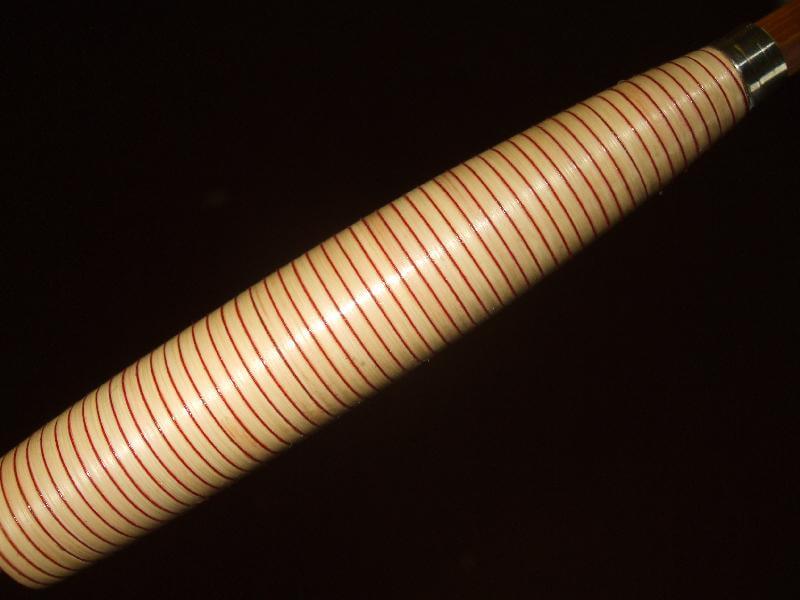
Rattan fly rod grips are a durable and aesthetically pleasing alternative to traditional cork grips, offering increased sensitivity and a classic look. Silk thread is used to define and dress the wraps and varnish is used to seal the grip. The wood seat under the rattan transmits feel much better than cork which makes it great nymphing and streamers
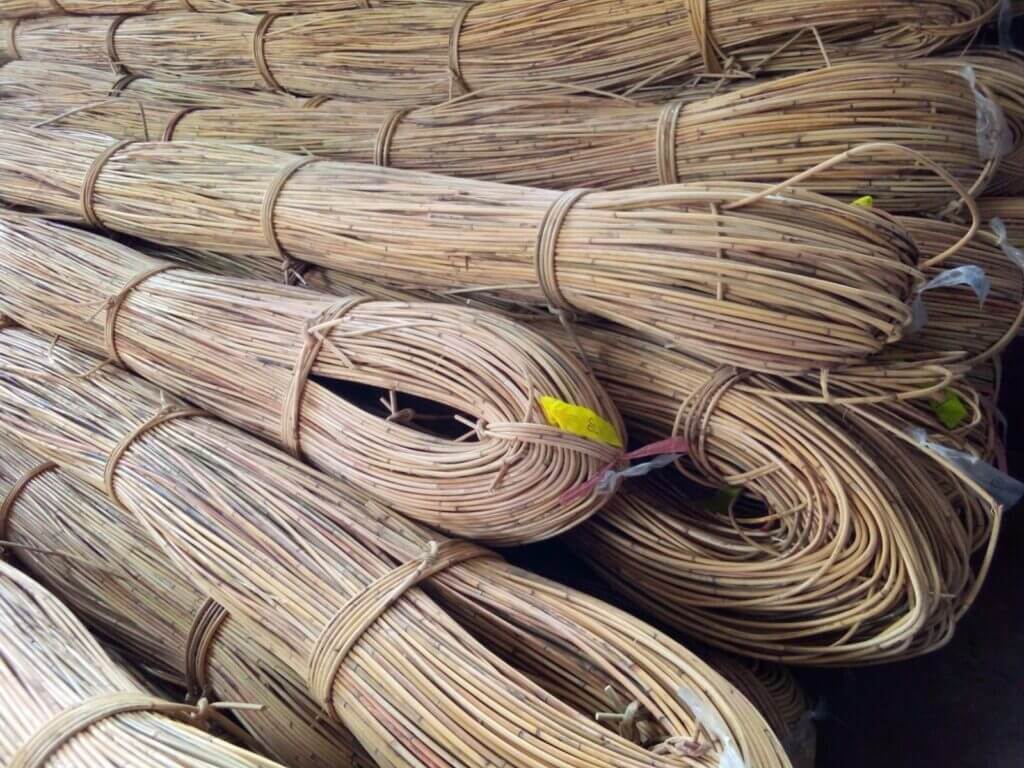
What is Rattan
- Cane – Rattan is a natural, climbing palm from tropical Asia, Africa, and Australia, prized for its strong, flexible stems. It is denser and stronger than bamboo, with inherent resistance to humidity, temperature changes, and insects.
- Cane was used before cork to make grips
Pros & Cons
- Durability: Rattan grips are highly durable and hard-wearing, long outlasting standard cork grips.
- Feel and Sensitivity: Exceptional wet and dry grip. Wound over a wood base, they are light, responsive, and provide increased sensitivity, which is beneficial for contact fishing such as streamers and wet fly fishing.
- Aesthetics: Distinctive appearance—no two grips are alike. Rattan offers a unique a very distinctive classic, and elegant old worldly look with options for different finishes like flaming and various accent thread colors.
- Maintenance: Sealed with varnish, they do not soak up water and are not slippery when wet.
- Shape – Grips that have minimal grade changes are best. Stay away from designs with too wide a flair. Narrower width rattan accommodates grade changes better.
- Cost – Rattan grips cost more due to the extra labor involved in the construction
Rattan offers a firm yet forgiving grip, staying secure whether your hands are wet, cold, or sun-warmed from a long day on the river. Unlike synthetic handles, rattan breathes, reducing slip and fatigue while delivering unmatched control during delicate presentations and hard-fought runs.
Each grip tells a story. Subtle variations in weave and color give every rod a one-of-a-kind character—earned, not manufactured. As seasons pass, rattan develops a rich patina, marking memories of early mornings, rising trout, and miles walked along wild water. What was old is new again.
On your next rod build consider a rattan grip and feel the difference of rattan.
AFFTA official fly line specifications & weights
| The American Fly Fishing Trade Association (AFFTA) provides standardized weights for fly lines, which you can find below. While most anglers simply use the general line weight measure when matching a line to a rod, occasionally more detailed information is useful. The table below provides the official measurements in both grains and grams. This may also be useful when trying to determine what line weight an unmarked line is, as you can simply place it on a precision scale. |
| STANDARD SINGLE-HANDED FLY LINES | |||||||
| (Weight is for the first 30′ of line minus level tip) | |||||||
| Line Weight | Weight in Grains | Weight in Grains | Weight in Grains | Line Weight | Weight in Grams | Weight in Grams | Weight in Grams |
| Low | Target | High | Low | Target | High | ||
| 1 | 54 | 60 | 66 | 1 | 3.5 | 3.9 | 4.3 |
| 2 | 74 | 80 | 86 | 2 | 4.8 | 5.2 | 5.6 |
| 3 | 94 | 100 | 106 | 3 | 6.1 | 6.5 | 6.9 |
| 4 | 114 | 120 | 126 | 4 | 7.4 | 7.8 | 8.2 |
| 5 | 134 | 140 | 146 | 5 | 8.7 | 9.1 | 9.5 |
| 6 | 152 | 160 | 168 | 6 | 9.9 | 10.4 | 10.9 |
| 7 | 177 | 185 | 193 | 7 | 11.5 | 12 | 12.5 |
| 8 | 202 | 210 | 218 | 8 | 13.1 | 13.6 | 14.1 |
| 9 | 230 | 240 | 250 | 9 | 14.9 | 15.55 | 16.2 |
| 10 | 270 | 280 | 290 | 10 | 17.5 | 18.15 | 18.8 |
| 11 | 318 | 330 | 342 | 11 | 20.6 | 21.4 | 22.2 |
| 12 | 368 | 380 | 392 | 12 | 23.8 | 24.6 | 25.4 |
| 13 | 435 | 450 | 465 | 13 | 28.2 | 29.2 | 30.2 |
| 14 | 485 | 500 | 515 | 14 | 31.1 | 32.4 | 33.7 |
| 15 | 535 | 550 | 565 | 15 | 34.3 | 35.6 | 36.9 |
| STANDARD SPEY FLY LINES | |||||||
| Shooting Heads | Short Belly | Medium Belly | Long Belly | ||||
| Line Style | H | S | M | L | |||
| Head Length | 30′-50′ | 50′-60′ | 60′-70′ | 70′ plus | |||
| Weight Point | 40′ | 55′ | 65′ | 80′ | |||
| Line Weight | Increment | grains / grams | grains / grams | grains / grams | grains / grams | ||
| 6 | 250 / 16.2 | 420 / 27.3 | 460 / 29.9 | 600 / 39 | |||
| 50 | |||||||
| 7 | 300 / 19.5 | 470 / 30.5 | 510 / 33.1 | 650 / 42.2 | |||
| 60 | |||||||
| 8 | 360 / 23.4 | 530 / 34.4 | 570 / 37 | 710 / 46.1 | |||
| 70 | |||||||
| 9 | 430 / 27.9 | 600 / 39 | 640 / 41.6 | 780 / 50.6 | |||
| 80 | |||||||
| 10 | 510 / 33.1 | 680 / 44.2 | 720 / 46.8 | 860 / 55.8 | |||
| 90 | |||||||
| 11 | 600 / 39 | 770 / 50 | 810 / 52.6 | 950 / 61.7 | |||
| 100 | |||||||
| 12 | 700 / 45.5 | 870 / 56.5 | 910 / 59.1 | 1050 / 68.2 | |||
Cleaning rod ferrules
Are your rod sections fitting together too tightly? Normal crud buildup in the female and male ferrules will cause the ferrule fit to be tight and lead to stuck ferrules. It is time to clean the ferrules. Ferrules need to be cleaned periodically to keep them tight and smooth. The best way to clean ferrules is with alcohol and a Q tip. It is best to start with the female ferrule. To clean the female ferrule, hold the section with the ferrule opening pointed down. Take a Q tip dipped in alcohol and insert the Q tip into the female twirling the Q tip round to clean out the dirt and grime buildup. Next with an alcohol soak cloth, wipe the male ferrule slide of grime. Check the fit of the male to female connection. The male ferrule should insert into the female leaving an ~1/8 gap. This will get you ready for the next season and forego and ferrule fit issues.
What is a “Dry fly” rod
Scarf Repair For Your Bamboo Flyrod
The worst has happened – You have broken a section of your fly rod into two pieces! Is it ruined? Is the only fix to have a rod maker make a new section for you? An expensive proposition. The solution:
Continue reading Scarf Repair For Your Bamboo FlyrodWhy I fish with bamboo rods
 If you haven’t fished with a bamboo fly rod, then you may be wondering what all the buzz is about. Isn’t bamboo old technology, something to hang on the wall and admire but they certainly can’t complete with today’s modern graphite rods, can they? Don’t you need special lines with bamboo? Aren’t they made for fly fishing snobs to impress their buddies? Besides aren’t bamboo rods too delicate, too heavy, too expensive, too slow, too, too, too… Continue reading Why I fish with bamboo rods
Fly Rod Grips
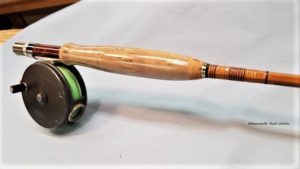 Fly rod handles also called grips play an important role in fly rod design. Other than the rod taper, grips greatly determine your ability to control the fly rod in your casting stroke. In addition, having the right grip for your fly rod can mean the difference between a comfortable day of fly fishing, or a day of fly fishing where your hands and arms ache with fatigue by the end of the day.
Bamboo rod repair
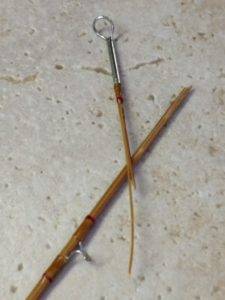 Bamboo rods are very resilient instruments, capable of withstanding years of use and even some abuse. After all rods are being fished today that were made 100 years ago.
At some time in their service, it is a good chance that a fly rod will need repair. It may be minor such as a loose guide or more substantial such a broken tip. The good news is that bamboo rods can almost always be repaired or refurbished for a relatively small amount of money. There are three basic approaches to servicing a fly rod.